Content of the Class
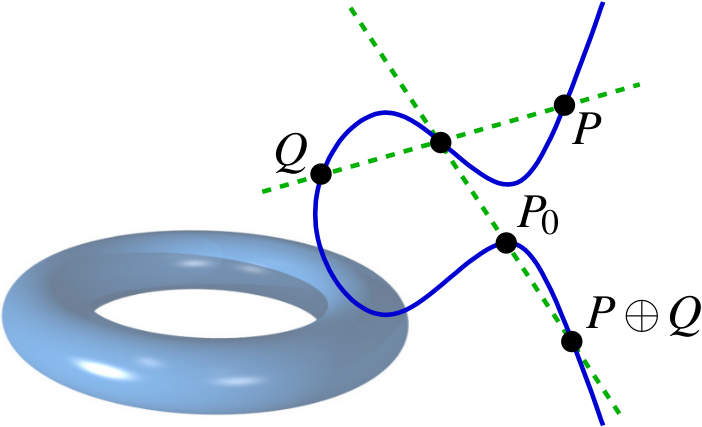
Given a polynomial in two variables, we can think of its zero locus as a curve in the plane. We then want to deduce geometric information on these curves from the algebraic properties of the polynomial. For example, we will figure out the local and global topology of the curves (in the case of the real or complex numbers as the ground field) and the number of intersection points of two curves. This class is the introductory lecture for the Algebraic Geometry specialization.
Prerequisites
You should have a basic knowledge of rings to the extent of the Algebraic Structures class. Knowledge of the Introduction to Algebra class may be useful in that it will have given you more experience with these algebraic structures, but the group theory and more advanced field (i.e. Galois) theory that is the main subject of this class will not be used. In addition, there are relations to the Introduction to Topology, Introduction to Complex Analysis, and Commutative Algebra classes that we will sketch, but again none of the results from there will be assumed.
News
Any news will be sent through the News tab of the OLAT course. You can configure OLAT so that these messages will also be sent to you by e-mail.
Dates and Times
- Lecture: Mon 14:00-15:30 (48-438), starting April 13
- Example class: Thu 12:15-13:45 (48-538), biweekly starting April 30
- Holidays: May 14 (Himmelfahrt), May 25 (Pfingstmontag)
- Substitute dates: Thu May 21 instead of May 14 for the example class
Registration for the Class
If you want to take part in this class please register for the example sessions until noon on April 17 in the URM system from the university network (or using VPN).
Homework assignments
Homework problems will be assigned biweekly on Mondays, starting on April 20. They can be downloaded below and are due on Mondays one week later (at any time). You can put your solutions in Diego's mailbox next to 48-210 or upload them as a PDF file in the Submissions tab of the OLAT course. You can submit them in groups of up to 3 students. Of course, in this case everyone should have their fair share both in finding and writing down the solutions; it is expected that everyone can explain their solutions on the blackboard in the example sessions. If you submit your solutions online as a group, only one of you should upload them and indicate the names of all participants on the solution.
Class Notes
This class is based on the notes from my SS 2023 class. There might be small changes however, and I will update the notes correspondingly and make them available for download below as the semester progresses. This will take some time however, so do not count on the updated notes being available right after the lecture, or on time for the homework assignments. But don't worry, you will be fine just using the old notes as they are.
Video recordings of the class are available on the page of the class notes.
- Complete notes (12 pages, last updated April 13, 2026)
- Chapter 0: Introduction
- Chapter 1: Affine Curves
Credits
You will get a certificate for this class if you attend the example classes regularly and score at least 1 out of 4 points in at least 70% of the homework problems.
Literature
There is no need to use any further literature besides the notes above. However, it can sometimes be helpful for the understanding of the material to read about it somewhere else in other words. If you want to have a look at some books for this reason, here is a small selection for the beginning:
- W. Fulton: Algebraic Curves (2008)
- E. Kunz: Introduction to Plane Algebraic Curves, Birkhäuser (2005)
- F. Kirwan: Complex Algebraic Curves, Cambridge University Press (1995)
Questions?
If you have any questions – about the organization of the course, the lecture, the homework problems or whatever – do not hesitate to contact us! You can write an e-mail or in the forum, ask Diego (bargans@rptu.de, 48-518), talk to me after the lecture or just come at any time to my office (andreas@rptu.de, 48-517).